Last updated: April 2026
Quick answer
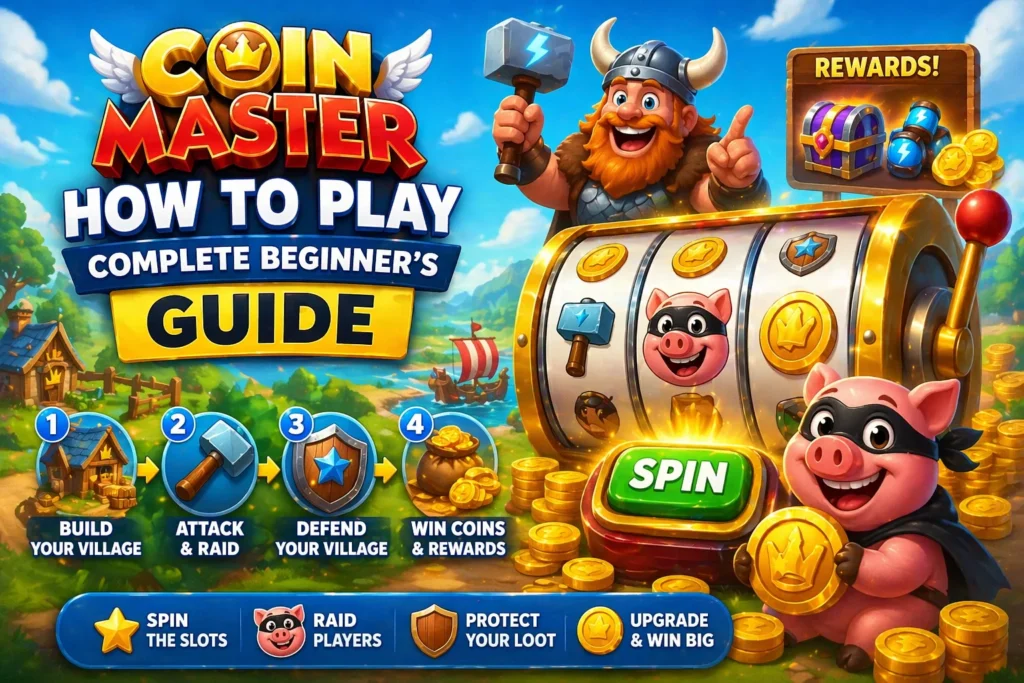
In Coin Master you spin a slot machine to earn coins, spins, attacks, raids and shields, then spend coins to build villages. Completing a village unlocks the next one. Pets, card collections and events multiply your rewards, so the key beginner habits are saving spins for events, building during Village Mania and linking Facebook for friend gifts.
Coin Master is easier to start than it looks and deeper than most players expect. The game gives you a slot machine, a village to build, and a world of other players to attack and raid. That sounds straightforward, but the interactions between spins, coins, pets, events, and village progression create a system with a lot of moving parts, most of which the tutorial does not explain properly.
This guide covers every core mechanic in the game from scratch. If you have just downloaded Coin Master and want to understand what you are doing, start from the beginning. If you have been playing for a few weeks and feel like you are missing something, the sections on pets, shields, and events are where most beginners find the gaps in their understanding.
In this guide
- How Coin Master Works
- How the Slot Machine Works
- What Are Spins Used For?
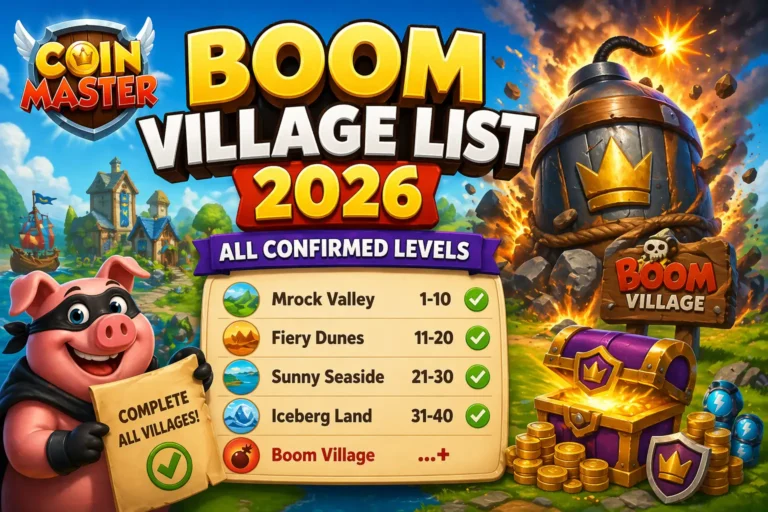
- How Villages Work
- How Attacks Work
- How Raids Work
- How Shields Protect Your Village
- What Do Pets Do?
- How Cards and Card Sets Work
- Which Events Matter Most?
- How Friends and Gifts Work
- How the Bet Multiplier Works
- Common Beginner Mistakes
- Frequently Asked Questions
How Coin Master Works
Everything in Coin Master flows from one activity: spinning the slot machine. Each spin consumes one spin from your reserve and produces one of several outcomes: coins, an attack, a raid, shields, or a combination. You use the coins you earn to build and upgrade your village. You use attacks and raids to take coins from other players. You use shields to protect your own village from being damaged.
That is the loop. Spin → earn resources → build → repeat. Understanding each part of that loop in detail is what separates players who progress quickly from players who spin through hundreds of spins and feel like they are going nowhere.
How the Slot Machine Works
The slot machine has five possible symbols. Each spin lands on three of them in a row. What you earn depends on which combination appears.
Coins: Landing on one, two, or three coin symbols gives you a direct coin payout. Three coin symbols gives the maximum coin payout for that spin. The amount you receive scales with your active bet multiplier and your current village level.
Hammer (Attack): Three hammers sends you to another player's village where you can choose one of their buildings to attack. A successful attack damages that building and earns you coins. If the target has shields, the attack hits a shield instead and no building damage occurs.
Pig (Raid): Three pigs sends you to another player's village to dig for coins. You choose three dig spots out of four on the ground, or all four if Foxy pet is active, and collect whatever coins are buried there. Raids are generally the highest single-spin coin yield in the game.
Shield: Landing on one, two, or three shield symbols gives you that many shields, up to your maximum of three. Shields absorb incoming attacks, protecting your buildings from damage. Once a shield is used, it is gone.
Energy Capsule (Rhino): A less common outcome that gives pet food, used to feed and level up your pets.
The outcomes are random. You cannot control what the slot machine lands on, but you can influence how much each outcome is worth through your bet multiplier, which pets you have active, and whether events are running. Those three factors are where strategy enters the game.
For a complete breakdown of every symbol combination, what each pays out at different village levels, and how the bet multiplier changes every outcome, the Coin Master slot machine guide covers the full mechanic in detail.
What Are Spins Used For?
Spins are what everything else depends on. Without spins you cannot earn coins, attack, raid, or participate in events.
The game gives you a free replenishment of five spins every hour up to a maximum reserve cap. That cap starts small and increases as you progress through villages. At early villages the cap is around 50. At higher villages it can reach several hundred.
Beyond the hourly replenishment, there are several ways to build your spin reserve without spending money. Friend gifts, daily links posted by Moon Active on their official social media channels, event milestone rewards, and Viking Quest completions are the main sources. The full guide to every legitimate spin source explains each one and how to prioritise them.
The one habit that matters most at the beginner stage is not wasting spins. Spinning randomly throughout the day with no awareness of what events are running, what your coin balance is, or whether your village is ready to build means you are burning spins for very little return. This guide will explain the context that makes each spin more valuable.
How Villages Work
A village is a set of five buildings. Each building has multiple upgrade levels. You upgrade buildings by spending coins. When all five buildings are fully upgraded, the village is complete and you move to the next one.
There are currently more than 570 villages in Coin Master. Each one has a different theme and visual design. The gameplay mechanics do not change between villages, but the coin cost to complete each village increases significantly as you progress. Early villages cost millions of coins. Mid-game villages cost billions. Late-game villages cost trillions.
This cost scaling is the most important thing a beginner can understand about village progression. The habits that get you through Village 10, spinning whenever you have spins, building whenever you have some coins, stop working around Village 30 to 50 because the coin requirements outpace casual play. From that point, efficient coin farming and strategic timing become necessary.
The most important single rule for village building is this: never start upgrading a village until you have enough coins in your balance to complete every upgrade in one session. Starting a village and then running out of coins midway leaves your buildings partially upgraded and exposed to attack damage, which means you pay repair costs on top of the original upgrade cost. Hoard first, then build everything at once.
The complete village levels guide covers the full cost structure from Village 1 to the latest village, when costs jump from millions to billions to trillions, and what changes at each stage of progression.
How Attacks Work
When your slot machine lands on three hammers, you are taken to the attack screen. You see another player's village with their buildings visible. You tap one building to attack it.
If the target has no shields, the attack damages the building. The building's owner will need to spend coins to repair it before they can upgrade it again. You receive a coin reward for the successful attack, the amount depends on your village level and active bet multiplier.
If the target has shields, the attack hits a shield instead. Their building takes no damage, one of their shields disappears, and you still receive a smaller coin reward for the attack outcome.
You cannot choose your attack target from scratch, the game selects a random player from your friends list or the general player pool. You can cycle through available targets using an arrow button on the attack screen, which lets you skip to a different player without using your attack. This is useful for finding targets at a higher village level, since coin rewards from attacking higher-village players are larger.
Tiger pet increases the coin reward you earn from every attack. At higher Tiger levels, this bonus is significant enough that keeping Tiger active during attack-heavy sessions, especially Attack Madness events, sharply increases what each attack earns. The attack Madness strategy guide covers how to combine Tiger with the event structure to maximise attack session output.
How Raids Work
When your slot machine lands on three pigs, you are taken to the raid screen. You see another player's village from above, with the ground visible. Coins are buried in four spots underground. You choose three spots to dig, the game reveals how many coins were in each spot you selected.
If Foxy pet is active at Village 4 or above, you automatically dig all four spots instead of three. This makes Foxy one of the most valuable pets in the game for coin farming, since every raid with Foxy active collects 100% of the available coins rather than 75%.
The coin amounts available in each raid scale with the target player's village level. Raiding a high-village player returns significantly more coins than raiding a low-village player. You can cycle through raid targets the same way you can cycle through attack targets.
Raids are the highest single-spin coin yield in the game under normal circumstances, particularly when combined with Foxy and during Raid Madness events. The Raid Madness guide explains how the event multiplier stacks with Foxy's bonus and what that combination produces at different village levels.
How Shields Protect Your Village
Shields absorb incoming attacks. When another player lands three hammers and targets your village, a shield takes the hit instead of your building. You can hold a maximum of three shields at one time.
Shields come from the slot machine: landing on one, two, or three shield symbols gives you that many, up to the three-shield cap. Any shield symbols that appear when you are already at three are lost with no compensation.
The key things to understand about shields as a beginner:
Shields only block attacks. They do not protect against raids. If another player raids your village, they dig coins regardless of how many shields you have. Shields and raid protection are separate problems that require separate solutions.
The most important time to have shields active is before and during a village build. Partially upgraded buildings that get attacked cost you repair coins on top of the original upgrade cost. Going into a build session with three active shields is one of the simplest and highest-value habits in the game.
When your village is fully complete, shields have less urgency, there are no buildings to damage until you start the next village. Between builds, prioritising coin accumulation over shield collection is often the right approach.
The complete shields guide covers when shields matter, when they do not, and how Rhino pet changes the calculation at higher village levels.
What Do Pets Do?
Pets are companions that give you passive bonuses while active. You have three pets: Foxy, Tiger, and Rhino. Only one can be active at a time until you reach Village 200, where the Pet Crew feature unlocks and allows all three to run simultaneously for four hours.
Each pet is fed with pet food to level it up. Higher levels increase the strength of the bonus. Pets remain active for four hours after feeding, then go to sleep until fed again.
Foxy unlocks at Village 4 and adds a percentage bonus to every raid payout. Foxy also unlocks the fourth dig spot in every raid, meaning you collect from all four ground spots instead of three. Foxy is the most impactful pet for coin farming at most stages of the game.
Tiger adds a percentage bonus to the coin reward from every attack. Tiger is most useful during Attack Madness events, where its bonus stacks with the event multiplier.
Rhino blocks a percentage of incoming attacks against your buildings. At higher Rhino levels, this block chance is significant. Unlike shields which provide a fixed number of guaranteed blocks, Rhino gives a percentage chance to block any attack, which scales better at high village levels where you face frequent attacks on expensive buildings.
As a beginner, the most important pet habit is simply keeping Foxy active whenever you are spinning. The difference in coin output between raiding with Foxy active versus without is large enough that consistently not using Foxy is one of the most common reasons newer players feel coin-starved. The complete pets guide covers every pet's stats, level progression, and when each one should be prioritised.
How Cards and Card Sets Work
Cards are collectibles you earn by opening chests. Each card belongs to a themed set. When you complete a full set, collecting every card in it, you receive a reward of spins, coins, XP, and sometimes pet food.
Chests are the primary source of cards. Different chest tiers have different drop rates for rare cards. Higher-tier chests cost more coins to open but have a better chance of containing the rarer cards that are harder to complete sets with. The chest and card drop rates guide covers exactly what each chest tier offers and which ones are worth spending coins on.
Cards can also be traded with other players. The trading system lets you send a card to another player in exchange for one they send back. Trading is the practical solution for the cards you cannot seem to pull from chests, finding another player who has your missing card and wants one of your duplicates is often faster than opening dozens of chests hoping to land on it randomly.
Gold cards are a rarer variant of specific cards in each set. Completing a set that includes gold cards gives a larger reward than completing the same set with standard cards. Gold card trading is restricted during certain periods, the game disables it at the start of new card sets.
Which Events Matter Most?
Events are time-limited challenges that run for a day or a few days and reward players for completing specific in-game actions. Most meaningful coin and spin gains at mid-to-high village levels come from events rather than from random daily spinning.
As a beginner, the events to pay attention to first are:
Raid Madness: Raid payouts are multiplied during this event. Combined with Foxy, this is the highest coin-per-spin output available in the game. Save your spin reserve for Raid Madness sessions rather than spending it on ordinary days.
Attack Madness: Attack coin rewards are multiplied. Tiger pet stacks with the event multiplier. Running a high-bet Attack Madness session with Tiger active generates significantly more coins per spin than attacking outside the event.
Village Mania: Building costs are reduced by 50% during this event. At mid-to-high village levels this saving is worth billions of coins. Never build a new village without checking whether Village Mania is active or about to start.
Viking Quest: A separate side slot that runs on coins and pays out spins on completion. One of the highest single-session spin sources in the game without spending money.
The Village Mania vs Village Master guide explains how to identify when both events are running simultaneously and how to build during that window to compound the benefits of both at the same time.
The general principle for all events is simple: your spins are worth more during the right event than on a random day. Checking what event is active before you spend a large session of spins is the single habit that most improves your coins-per-spin ratio as a beginner.
How Friends and Gifts Work
Connecting Coin Master to Facebook allows you to see friends who play the game, send them daily spin gifts, and receive spin gifts from them in return. The gift exchange is a consistent free spin source, with an active friends list, you can receive dozens to hundreds of extra spins per week purely from daily exchanges.
Facebook connectivity also enables card trading with friends, which is the most reliable way to complete card sets faster. Friends can also visit your village and you can visit theirs, which sometimes triggers bonus events.
You do not need to play with real-life friends. Large Coin Master communities on Facebook and Reddit are specifically organised around spin gift exchanges and card trades with strangers who play actively.
How the Bet Multiplier Works
The bet multiplier lets you increase how much each spin pays out by spending multiple spins per single pull. At ×3, each spin costs 3 spins from your reserve but pays out triple the coins, attack rewards, and raid yields. At ×10, each spin costs 10 but pays out ten times. The multiplier goes up to ×400.
For beginners, the bet multiplier is most useful in two situations: spinning during Raid Madness or Attack Madness when you want to maximise the per-spin coin output, and working through Viking Quest faster when the side slot rewards make the higher spend worthwhile.
The mistake beginners make with the bet multiplier is running high bets on ordinary days with no event active. High bets burn through your spin reserve quickly, and without an event multiplier stacking on top, the coin output does not justify the spin cost. The bet multiplier guide covers exactly when each multiplier level makes sense and when running at ×1 is the correct choice.
Common Beginner Mistakes
Starting a village build without enough coins to finish it. This is the most expensive mistake in the game. A partially upgraded village is vulnerable to attacks, repair costs compound on top of upgrade costs, and you end up spending more total coins on the same village than if you had waited until you had enough to complete it in one session.
Not using Foxy during raids. Every raid without Foxy active leaves coins on the table. Feed Foxy before any session where you expect to get raid outcomes.
Spinning during high bets with no event active. High bets are for events. On a normal day they burn your reserve for minimal extra return.
Ignoring the spin cap. If your spin reserve is full, hourly replenishment stops. Log in regularly or spend spins before collecting daily links so you are not hitting the cap and wasting the replenishment ticks.
Treating all spins as equal. A spin during Raid Madness at ×10 with Foxy active is worth sharply more than a spin on a random Tuesday at ×1 with no pet. The value of each spin is determined by context, not just the spin itself.
Frequently Asked Questions
How many villages are in Coin Master? As of mid-2026, there are more than 570 villages. Moon Active adds new villages periodically.
Do I need to spend real money to progress? No. All villages are completable without spending money. The game is free to play if you manage your resources efficiently. Spending money speeds up progress but is not required to reach any content.
What happens to my shields when I complete a village? They carry over to the next village. Completing a village does not reset your shields.
Can other players attack me while I am offline? Yes. Attacks and raids can happen at any time regardless of whether you are logged in. This is why having shields active before you go offline, especially if you have coins in your balance or a partially built village, matters.
What is the fastest way to earn coins as a beginner? Raiding with Foxy active during Raid Madness at the highest bet multiplier your spin reserve can sustain. At early village levels the coin amounts are small in absolute terms but the principle is the same as at higher levels, the combination of Foxy plus Raid Madness plus a high bet multiplier is the highest coins-per-spin output available.
What should I focus on first as a new player? Get Foxy unlocked and active as quickly as possible (Village 4), build the habit of never starting a village build without enough coins to finish it, and start checking what event is running before you spend large spin sessions. Those three habits cover the majority of the mistakes that slow down new players.
How does card trading work? You can send a card from your collection to another player, and they send one back to you. Both players must agree to the trade. You can only trade cards you own duplicates of, cards you have only one copy of are locked. Gold cards have additional trading restrictions that vary by event period.

Johnson Del Rosario has played Coin Master since 2022, has completed over 280 villages and moderates several Coin Master Facebook groups. He writes our strategy, event and rewards guides.
How we check our guides: editorial policy.