Last updated: April 2026
Quick answer
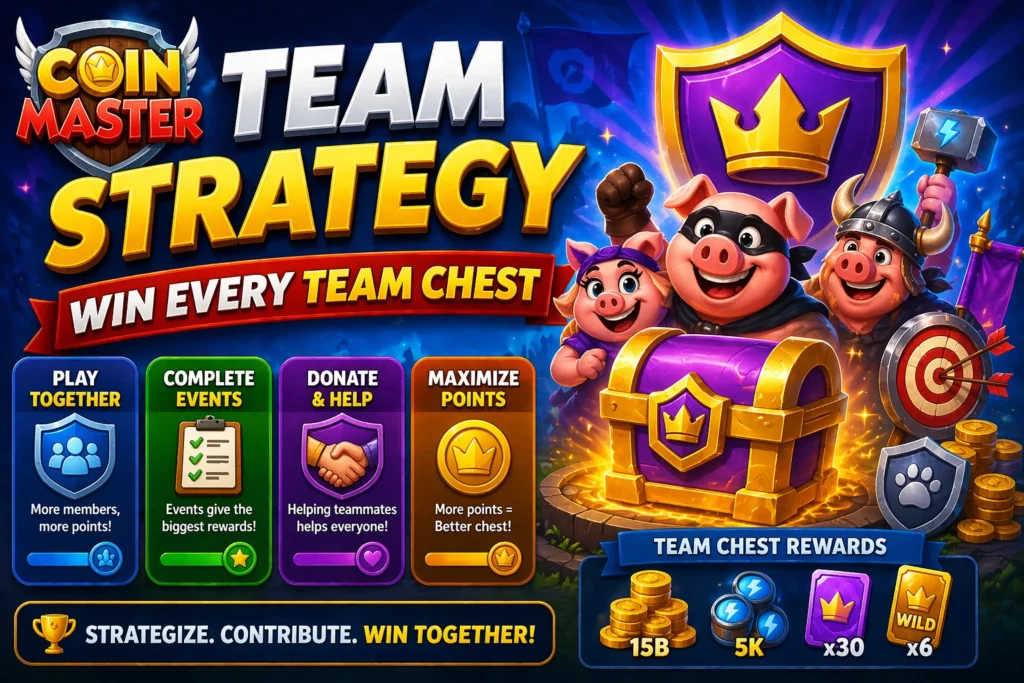
In Coin Master teams, every time your team fills the progress bar, each contributing member receives a team chest, and active teams reach better chest tiers. Join an active team whose members play daily, contribute every week, and use the team to trade cards and exchange gifts.
Teams in Coin Master are one of the most overlooked features in the game. Most players join a team early on, barely interact with it, collect the occasional chest reward when their team happens to hit a milestone, and never think much about it again. That is a significant missed opportunity, because a well-chosen, active team contributes to your progression in ways that go well beyond the chests themselves.
Done properly, your team becomes a source of regular card rewards, a community for card trading, a social engagement signal that supports your Loyalty Club standing, and a consistent weekly bonus that active members collect while passive ones miss entirely. This guide covers how teams work, how to find one that suits your playing style, how to contribute effectively, and how to maximise what you take out of team chests every single week.
In this guide
- How Teams Work in Coin Master
- How Do Team Chests Work?
- How to Find the Right Team
- How to Contribute Effectively to Your Team
- Trading Cards With Your Team
- Teams and the Loyalty Club
- What to Do If Your Team Is Inactive
- Team Strategies for Different Playing Styles
- Common Team Mistakes
- Frequently Asked Questions
How Teams Work in Coin Master
Every Coin Master player can join a team of up to 50 members. Teams have a collective goal: earning enough points across all members to fill a shared progress bar that, when completed, unlocks a Team Chest for everyone who contributed. The chest contains cards, the type and quality depend on how many times the team has completed the bar and what chest tier the team has reached.
Points toward the team bar are earned through spinning. Every spin you take contributes a small amount of progress to the shared bar. The more members who are actively spinning, the faster the bar fills. A team of 50 highly active players can complete multiple team chest cycles in a single week. A team of 50 barely active players might not complete one cycle in a month.
This is the core reason team selection matters. The team chest rewards are identical in structure regardless of how you personally contributed, what changes is how frequently your team completes cycles, which determines how many chests per week you receive.
How Do Team Chests Work?
Team chests are the primary tangible reward from team participation. Each time your team fills the progress bar, every contributing member receives a team chest in their account. The contents of that chest are determined by which chest tier your team has reached through cumulative completions.
Team chests progress through tiers as your team completes more cycles:
| Team Chest Tier | Contents | How to Reach It |
|---|---|---|
| Wooden Chest | Common and occasional uncommon cards | Starting tier, all new teams begin here |
| Golden Chest | Uncommon and rare cards, small spin bonus | After several completed cycles |
| Magical Chest | Rare, epic, and occasional legendary cards | High-activity teams with consistent completions |
| Ruby Chest | Best card yield, pet food, XP potions, spins | Top-tier active teams with long completion histories |
The Ruby Chest is where team rewards become impactful. It bundles cards, pet food, XP potions, and spins together, making it one of the most resource-complete chests available in the game. Reaching and maintaining Ruby Chest tier requires being on a consistently active team, which is another reason joining the right team matters far more than most players appreciate.
Cards from team chests follow the same drop rate rules as purchased chests of the same type. Opening a team Magical Chest has the same probability of dropping rare and legendary cards as buying a Magical Chest from the shop. The difference is that team chests cost you nothing beyond your regular spinning. For a full breakdown of what each chest tier drops and the exact rarity probabilities, the chests and card drop rates guide has the complete data.
How to Find the Right Team
Finding a good team is more important than most guides acknowledge. The default approach, joining the first team that accepts you, typically lands you in a low-activity group where the bar fills slowly, chest tiers stay low, and the weekly reward is a Wooden Chest with common cards you already have hundreds of.
What to look for when evaluating a team:
- Bar completion frequency. The most reliable indicator of team activity. If a team is completing the chest bar multiple times per week, it is full of active spinners. If the bar barely moves in a week, it is not.
- Current chest tier. A team at Magical or Ruby Chest tier has earned its way there through consistent activity. Joining at this level gives you immediate access to better rewards rather than building up from Wooden Chest again.
- Member count near the cap. A team with 48 or 49 of 50 slots filled signals that people want to be there and are not leaving. A team with 15 members out of 50 tells a different story.
- Village level compatibility. Teams where members are at similar village levels to you tend to be more cohesive. Players at similar progression stages share similar goals, similar event schedules, and similar trading interests.
The best place to find highly active teams is within Coin Master community groups on Facebook and Discord. Many groups have dedicated team recruitment sections where team leaders post their stats: current chest tier, weekly completion rate, and requirements for joining. Finding a team this way takes 10 minutes and produces significantly better results than in-game team search alone.
How to Contribute Effectively to Your Team
Contributing to your team's progress bar requires nothing beyond your regular spinning, every spin you take contributes automatically. There is no special team mode or separate action required. However, the rate at which you contribute, and when you contribute, affects how much value you personally add to the team's weekly cycle.
A few things that make you a high-value team member:
- Spinning daily rather than in occasional large bursts. Consistent daily spinning adds to the bar every day of the week. A team member who spins 200 times every day contributes more bar progress across a week than a member who spins 1,000 times on one day and nothing for six days, even though the total spin count is lower. Daily consistency compounds across all 50 members and keeps the bar moving steadily.
- Spinning during active events. Events do not directly increase the bar progress per spin, but they increase your spin output by generating more resources that fund continued spinning. A member who spins actively during Raid Madness and Attack Madness sustains a higher overall weekly spin volume than one who only spins on quiet days.
- Staying active during team chest completion pushes. Many active teams have informal periods, usually toward the end of the week, where members push hard to complete the final portion of the bar before it resets. Being active and contributing during these windows helps the team close cycles faster and benefits everyone with an additional chest.
Trading Cards With Your Team
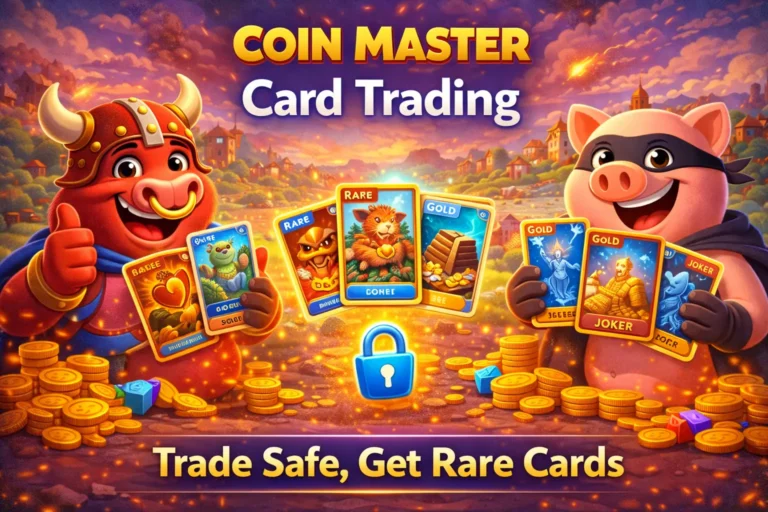
One of the most underappreciated benefits of being on an active, engaged team is the card trading network it provides. A team of 50 active players at similar village levels is a built-in trading community. These players are collecting cards from the same sets you are, accumulating the same duplicates, and looking for the same rare cards you need.
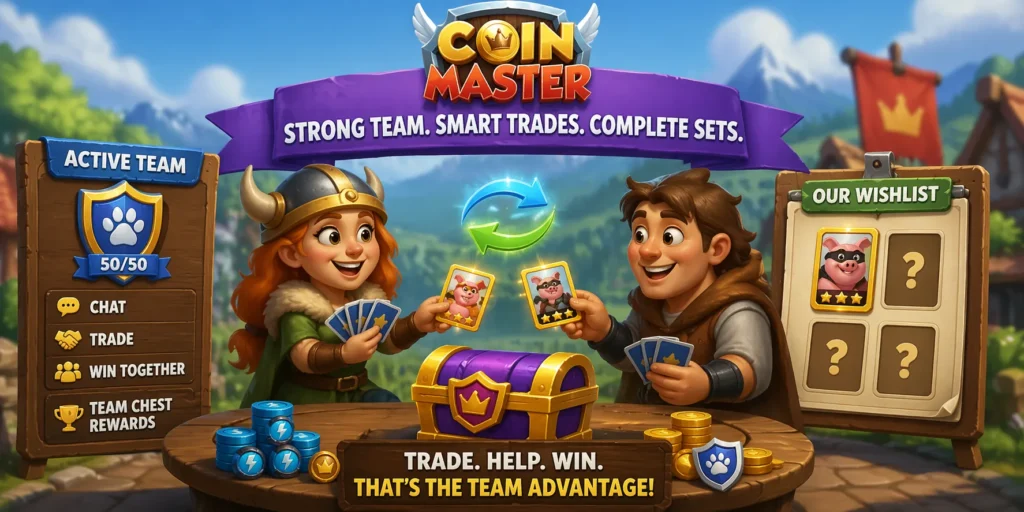
Teams that have an internal communication channel, through the in-game chat, a shared Discord, or a Facebook group, become self-sufficient trading pools that reduce your dependence on public trading groups where scam risk is higher and response times are slower. Trusted teammates who you have played alongside for weeks are safer trading partners than strangers in a public group.
When a Gold Card Trade event opens, an active team with a communication channel can coordinate gold-for-gold trades internally before going to public groups. Members who already know each other's wishlists and card holdings can complete high-value trades in minutes rather than hours. The full mechanics of safe card trading, including how to protect yourself during gold card trades, are in the card trading guide.
Teams and the Loyalty Club
Teams help indirectly with the Loyalty Club. Receiving gifts is one of the ways Moon Active lists for earning loyalty points, and an active team full of players who gift each other every day means more gifts coming in. The club itself unlocks automatically at Village 210, so a team does not affect whether you can join. See the loyalty points guide.
What to Do If Your Team Is Inactive
Every player eventually encounters the moment when their team becomes inactive. Members stop spinning, the bar stops moving, weekly chests drop from Magical back to Golden, and then to Wooden. This is surprisingly common: teams that were active when you joined gradually lose members to inactivity, and without recruitment the team hollows out.
Signs your team has gone inactive:
- The team chest bar has not completed in two weeks or more
- The member count has dropped significantly from when you joined
- The team chat has no messages in several days
- Your weekly chest tier has dropped compared to when you first joined
When these signs appear, you have two options. The first is to leave and find a better team. There is no penalty for leaving a team in Coin Master beyond any uncollected pending chest reward. Collect your current reward first, then leave. The second option is to become a recruiter yourself, actively finding and inviting active players to replace the inactive ones. This is more effort but can revive a team that has good bones.
Most experienced players leave inactive teams rather than trying to fix them, especially at higher village levels where the chest tier difference between an active and inactive team is significant. Time spent nursing an inactive team back to health is time better invested in finding one that is already working.
Team Strategies for Different Playing Styles
If you are a casual player (under 200 spins per day)
Look for a mid-tier team that is active but not elite. Teams at Magical Chest tier with a moderate completion rate are a good fit. You will contribute meaningfully, collect good cards consistently, and not feel pressure to perform at levels your play style cannot sustain. Avoid elite teams that have activity requirements you cannot meet, getting kicked for low contribution wastes everyone's time.
If you are an active player (200 to 1,000 spins per day)
Aim for teams at Magical to Ruby Chest tier with fast completion rates. You have the spin volume to contribute at a level that matches these teams and benefit from the Ruby Chest rewards that justify the investment. These teams typically have small communities around them, joining their Discord or Facebook group turns the team relationship into something more valuable than a passive weekly chest.
If you are a high-volume player (1,000+ spins per day)
Seek out elite teams explicitly or consider creating your own. At this spin volume you are one of the most valuable members any team could have. Top teams at Ruby Chest tier that complete the bar multiple times per week are the right environment. Your contribution rate at this level means you should be collecting the best available chest tier every single week without exception. Understanding how to sustain this spin volume long-term through events, Viking Quest, and daily free spin sources is covered in the free spins guide.
Common Team Mistakes
- Staying on an inactive team out of loyalty to old members. Emotional attachment to a team you built history with is understandable, but if the team is no longer producing chest rewards at a meaningful rate, you are paying an opportunity cost every week you stay. Move on and find an active team. You can always reconnect with old teammates through other channels.
- Joining a team with no communication channel. A team that only interacts through in-game chat and nothing else is rarely the most active or cohesive. Teams with external Discord or Facebook communities are almost always more engaged, better organised for events, and more useful for card trading.
- Not collecting your team chest before leaving. If you decide to leave a team, check whether there is a pending chest reward from a recently completed bar cycle. Leaving before collecting it means losing that reward permanently.
- Choosing a team based on name or theme rather than activity metrics. Team names and themes are irrelevant to performance. The only metrics that matter are current chest tier, completion frequency, and active member count. A team called "Elite Champions" that has 12 members and completes one Wooden Chest per month is worse than an unnamed team at Ruby Chest tier completing the bar three times a week.
Frequently Asked Questions
How many members can a Coin Master team have?
A Coin Master team can have a maximum of 50 members. Teams can operate with fewer members but completion rates and chest tier maintenance are directly affected by how many active spinners are contributing. A full team of 50 active players completes chest cycles faster and more reliably than a partial team.
Do I need to do anything special to contribute to the team chest bar?
No. Every spin you take automatically contributes progress to your team's chest bar. There is no separate team mode, no special button, and no minimum spin requirement per session. As long as you are spinning regularly, you are contributing.
What happens to my team chest if I leave the team?
Any pending team chest from a completed bar cycle that you have not yet collected is lost when you leave. Always collect your current chest reward before leaving a team.
Can I create my own team in Coin Master?
Yes. Any player can create a new team from the Teams section of the game. Creating a team costs a small amount of in-game currency. Building a team from scratch requires active recruitment to reach the member numbers that make completion rates competitive with established teams.
Does team performance affect my personal Loyalty Club status?
Teams help indirectly: receiving gifts is one of the official ways to earn loyalty points, and active teammates send gifts every day. The Loyalty Club itself unlocks automatically at Village 210.
How often do team chests reset or cycle?
There is no weekly hard reset on the team chest bar. The bar fills continuously as members spin and resets when a cycle is completed and the chest is distributed. Faster teams complete multiple cycles per week. Slower teams may take a week or more per cycle. The chest tier itself does not reset, it is earned progressively through cumulative completions and does not drop unless the team goes significantly inactive.
What village level should I be at before focusing on team strategy?
Team participation is valuable from any village level, but the card rewards from team chests become more meaningful once you are past the very early villages where all cards are plentiful from basic chest openings anyway. From around Village 30 to 50 onward, the rare and epic cards available from higher-tier team chests start filling gaps in your collection that basic chest openings cannot easily address. The milestone map of what unlocks at each village stage is covered in the village levels guide.

Johnson Del Rosario has played Coin Master since 2022, has completed over 280 villages and moderates several Coin Master Facebook groups. He writes our strategy, event and rewards guides.
How we check our guides: editorial policy.