Last updated: April 2026
Here is the thing about Coin Master loyalty points that frustrates every player who tries to understand them: Moon Active has never published how they work. There is no points counter visible in the game. There is no breakdown in the settings screen. There is no official document explaining what each activity earns, how those points are weighted, or what threshold triggers a tier upgrade.
What does exist is four-plus years of player reports, tier upgrade timelines, activity logs shared in communities, and patterns that are consistent enough across thousands of accounts to draw real conclusions from. This guide is built on that evidence. It will not give you a formula with specific numbers — because no one outside Moon Active has those numbers. What it will give you is a clear picture of which activities carry the most weight, which ones barely register, and how to structure your play around the things that actually move your loyalty score.
The Invisible Score: How the System Actually Works
Moon Active’s loyalty system is a background scoring model. It runs continuously on your account without your knowledge or input, assessing your behaviour across multiple activity dimensions. At intervals — which are also unpublished — the system evaluates accounts against tier thresholds and either upgrades, maintains, or downgrades membership accordingly.
Think of it less like a points bar filling toward a goal and more like a credit score. You never see the number directly. What you see is the outcome — an invite arriving, a tier upgrade notification appearing, or a downgrade happening when activity drops. The score itself is always invisible.
This matters because it changes how you should think about loyalty activity. You are not grinding toward a specific number you can track. You are building a behavioural profile that Moon Active’s system evaluates holistically. Every action contributes to that profile, but the weighting is not equal across activities — and understanding the hierarchy of what matters most is exactly what this guide is for.
The Two Dimensions Moon Active Weighs
Based on consistent patterns from player reports, the loyalty scoring system appears to evaluate every account on two core dimensions simultaneously. Both matter, and neither one alone is sufficient.
Dimension 1: Recency
What you have done recently carries more weight than your historical activity. An account that was extremely active twelve months ago but has been quiet for the past six weeks has a weaker current loyalty score than an account that has been moderately active every single day for the past six weeks. The system places a heavier weighting on recent activity, which is why returning players who were once at Gold tier can find themselves at Bronze after a long break even though their overall lifetime activity is high.
This recency weighting appears to operate on a rolling window of roughly 30 to 60 days. Activity within that window is heavily weighted. Activity outside it still contributes to the profile but at a reduced rate. What you do this week matters more to your current loyalty score than what you did last year.
Dimension 2: Consistency
Regular moderate activity scores better than intense sporadic activity. An account that plays for 20 minutes every day for 30 days builds a stronger consistency signal than an account that plays for 10 hours on one day and then does nothing for two weeks — even if the total activity volume is higher in the second case. Moon Active’s system is specifically designed to reward the kind of engagement that keeps players returning daily, which is why consistency is weighted so prominently.
These two dimensions working together explain why the most common advice — log in every day and participate in every event — is genuinely correct even without knowing the exact point values. Daily login produces both recency and consistency signals simultaneously, making it the single most cost-effective loyalty activity available.
Activity Weighting: What Earns the Most
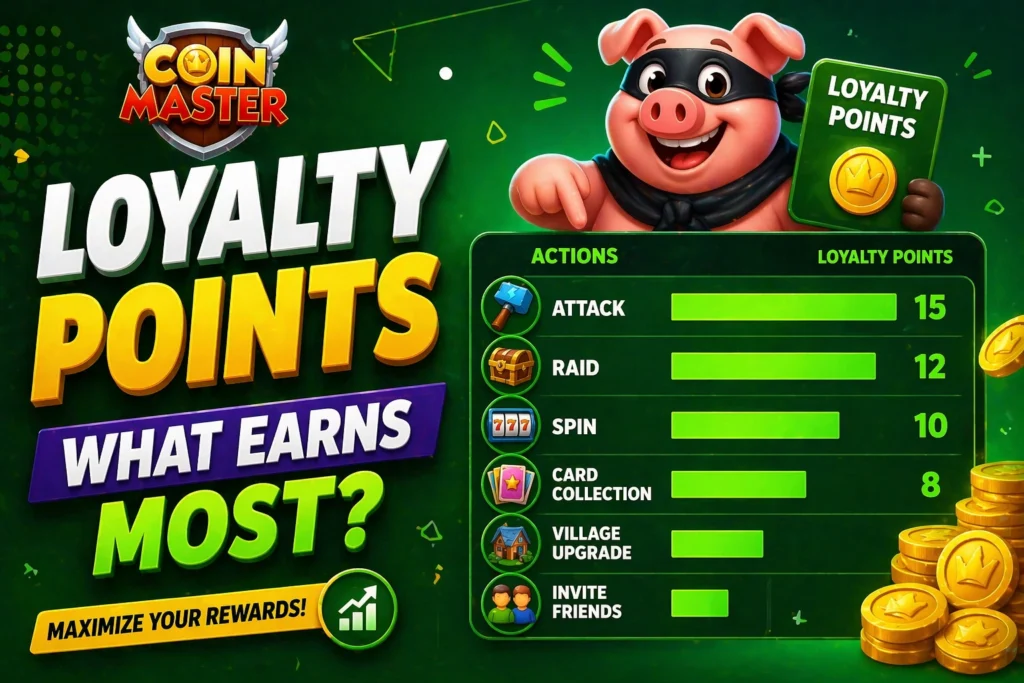
The table below organises loyalty-relevant activities by their estimated contribution to your score, based on patterns reported consistently across player communities. These are relative weights, not absolute point values.
| Activity | Estimated Weight | Why It Matters |
|---|---|---|
| Daily login with in-game action | Very High | Generates both recency and consistency signals every day. The single most important activity. |
| Event participation and milestone completion | Very High | Events are the clearest signal of active, invested play. Completing milestones scores significantly higher than merely entering events. |
| Village completions | High | Each completed village registers as a measurable progression event. Consistent village completion over time is a strong long-term loyalty signal. |
| Raid and attack activity | High | Core game loop actions. Regular raiding and attacking signals active gameplay rather than passive collection. |
| Daily gift exchanges with friends | Medium-High | Social engagement metric. Consistent gift sending and receiving shows community integration that Moon Active values. |
| Card set completions | Medium | Meaningful in-game achievement. Less frequent than raids or attacks but registers positively each time it occurs. |
| In-app purchases | Medium | Signals genuine player investment. Even small purchases contribute. Not required but accelerates scoring. |
| Team participation | Medium | Contributing to team chests shows group engagement. Weaker than individual gameplay signals but still tracked. |
| Spin volume (total spins used) | Medium | Raw spin consumption indicates active play. Matters as a supporting signal but less than event-specific activity. |
| Opening the app without gameplay | Very Low | A login with no in-game action produces almost no meaningful signal. Session depth matters, not just presence. |
The Activity That Surprises Most Players: Session Depth
The distinction between a login and a meaningful session is one of the most underappreciated nuances in the loyalty scoring system. Many players believe that opening the app daily is sufficient for loyalty purposes. It is not.
Moon Active tracks what happens during your session, not just whether a session occurred. An account that opens the game, spins 30 times, completes a daily gift exchange, and progresses an event milestone looks very different in the scoring model from an account that opens the game, checks the screen, and closes it after 10 seconds.
What constitutes a meaningful session from the system’s perspective:
- Spinning a minimum number of times — based on player reports, somewhere between 10 and 30 spins seems to constitute an active session versus a passive check-in
- Collecting daily gifts from the Loyalty Club calendar if you are already a member
- Completing at least one gift exchange with a connected friend
- Taking at least one raid or attack action if the slot produces one during the session
You do not need to play for hours. A consistent 10 to 15 minute daily session that covers all four of the above produces significantly stronger loyalty signals than an hour-long session once a week with nothing in between.
Events: The Highest Density Loyalty Activity Available
If daily login is the most important consistent habit, events are the highest single-session loyalty scoring opportunity. The reason is density — a well-executed event session produces raid activity, attack activity, spin volume, potential card set completions, and milestone progress all at once, in a single window of play. Each of those is a separate positive signal, and they all generate simultaneously during the same session.

From a loyalty scoring perspective, a player who completes four full event milestones during an Attack Madness session generates more signal in one hour than a player who casually spins for 20 minutes on six separate days with no events running — even if the total spin count is similar.
The events that appear to generate the strongest loyalty signals based on player upgrade timelines are:
- Attack Madness and Raid Madness. High raid and attack activity in concentrated bursts. These are the events most consistently cited by players who notice tier upgrades shortly after running full sessions.
- Viking Quest. A full run completion registers as a distinct achievement event in your account history. Players who run Viking Quest regularly report stronger loyalty progression than those who skip it.
- Village Mania completion. Completing a village during Village Mania combines a village progression event with an active spending event — both of which are separately tracked signals appearing simultaneously.
What Does Not Earn Loyalty Points (Contrary to Popular Belief)
Some activities players assume contribute to loyalty scoring appear to have little or no measurable effect based on player data:
- Watching ads for spins. Ad views appear to produce negligible loyalty signal. The spins earned from ads contribute to spin volume, which has some weight, but the ad-watching action itself does not appear to register as a positive engagement metric.
- Collecting daily free spin links from social media. Link collection happens outside the game app itself. There is no evidence that collecting external links contributes to in-app loyalty scoring. The spins you earn and then use inside the game do contribute — but the link collection action does not.
- Having a large friend list without active exchanges. Friend count alone appears to carry minimal weight. What matters is active gift sending and receiving. A friend list of 500 people you never exchange gifts with generates less signal than a list of 20 people you exchange with daily.
- Spinning at high bet levels specifically for scoring. There is no evidence that bet level affects loyalty scoring directly. Higher bets lead to more coins, which leads to faster village completion, which does score — but the bet level itself is not a direct scoring variable.
How Long It Takes to See Results
One of the most common questions from players who have deliberately changed their habits to improve their loyalty score is: when will I see the upgrade? The honest answer is that there is no fixed timeline, but patterns from player reports give a reasonable expectation.
For players moving from no membership to a first invite:
- Players who were already moderately active and made targeted improvements report receiving invites between 4 and 12 weeks after changing habits
- Players starting from a low activity baseline typically report 8 to 16 weeks before an invite appears
- Players at high village levels with strong event participation histories sometimes see invites within 2 to 4 weeks of improving their daily session depth and gift exchange consistency
For players already in the club moving between tiers:
- Bronze to Silver: typically 4 to 8 weeks of consistent improved engagement
- Silver to Gold: typically 8 to 16 weeks — the threshold appears meaningfully higher
- Gold to Diamond: no reliable short-term timeline. Players at Diamond have almost universally been at Gold for several months or more before the upgrade appeared
These timelines compress when multiple strong signals appear simultaneously. A player who runs a full Viking Quest cycle, completes two villages during Village Mania, and pushes through four event milestones in a single week generates a denser cluster of positive signals than the same player spreading the same activity across two months. Periods of concentrated, high-quality play appear to be noticed by the system faster than the same activity diluted over a longer window.
Practical Weekly Habits That Build Loyalty Score Efficiently
Rather than thinking about loyalty scoring as a separate task, the most efficient approach is to build a weekly rhythm where the habits that produce loyalty signals are the same habits that make you a better Coin Master player regardless of the club.
A weekly structure that covers all major scoring dimensions:
- Every day: Open the app and complete a genuine 10 to 15 minute session. Spin at least 20 to 30 times. Complete your gift exchange with your most active friends. Collect your Loyalty Club calendar gift if you are a member.
- Every event window: Participate and push through at least three milestones. Do not just enter and spin a handful of times — commit to completing a meaningful portion of the event each time one runs.
- Once per week minimum: Check your near-complete card sets and either open chests or arrange trades to advance at least one set toward completion.
- Once per Viking Quest appearance: Run the full event if your coin reserve allows. The combination of coin investment, spin return, and achievement signal makes it one of the most efficient single-event loyalty activities available.
Players who maintain this rhythm consistently over 60 to 90 days typically report noticeable loyalty progression — either a first invite if they were not yet a member, or a tier upgrade if they were. The rhythm is not demanding in terms of time. What it requires is regularity, which is exactly what Moon Active’s system is designed to measure and reward. For a deeper look at how Moon Active’s tracking system works once you are already inside the club, the Loyalty Club tracking and ranking guide covers the full scoring model and the five specific strategies that move your tier upward.
Frequently Asked Questions
Can I see my loyalty points total anywhere in the game?
No. Moon Active does not display a loyalty points counter or progress bar anywhere in the game interface. The only visible output of the loyalty system is your current tier status inside the Loyalty Club section if you are already a member. For non-members, there is no visible indicator of how close you are to qualifying for an invite.
Do loyalty points reset at the start of each month?
There is no confirmed monthly reset. The system appears to operate on a rolling recency model rather than a calendar-based reset. Recent activity carries the most weight, older activity carries less, but there is no evidence of a hard reset where accumulated loyalty history is wiped at a fixed date.
Does spending real money increase loyalty points faster?
Yes, in-app purchases contribute to the loyalty scoring model. The effect is not on purchases alone but on the combination of purchases with active gameplay. A player who spends money but rarely logs in or participates in events is unlikely to see strong loyalty progression. A player who makes occasional modest purchases while maintaining consistent daily play and event participation sees purchases as an accelerating factor on top of an already strong profile.
Which single activity would improve my loyalty score the most if I changed only one thing?
Daily login with a genuine session, if you are not currently doing it consistently. The recency and consistency signals from daily active play form the foundation of every loyalty tier. All other activities build on top of that foundation. Without consistent daily sessions, everything else contributes at a reduced rate.
Do loyalty points carry over if I change devices?
Yes, as long as your account is properly linked to Facebook or email across devices. The loyalty score is attached to your account, not your device. Switching devices with a properly linked account does not affect your loyalty score or tier status.
Is it possible to lose all loyalty progress at once?
A complete removal from the Loyalty Club due to extreme extended inactivity has been reported by players who went completely inactive for 60 days or more. Tier downgrades from shorter periods of reduced activity are more common. Regular modest play is enough to maintain most tier levels once earned — the system is not designed to punish occasional quiet periods, only prolonged disengagement.