Last updated: April 2026
Quick answer
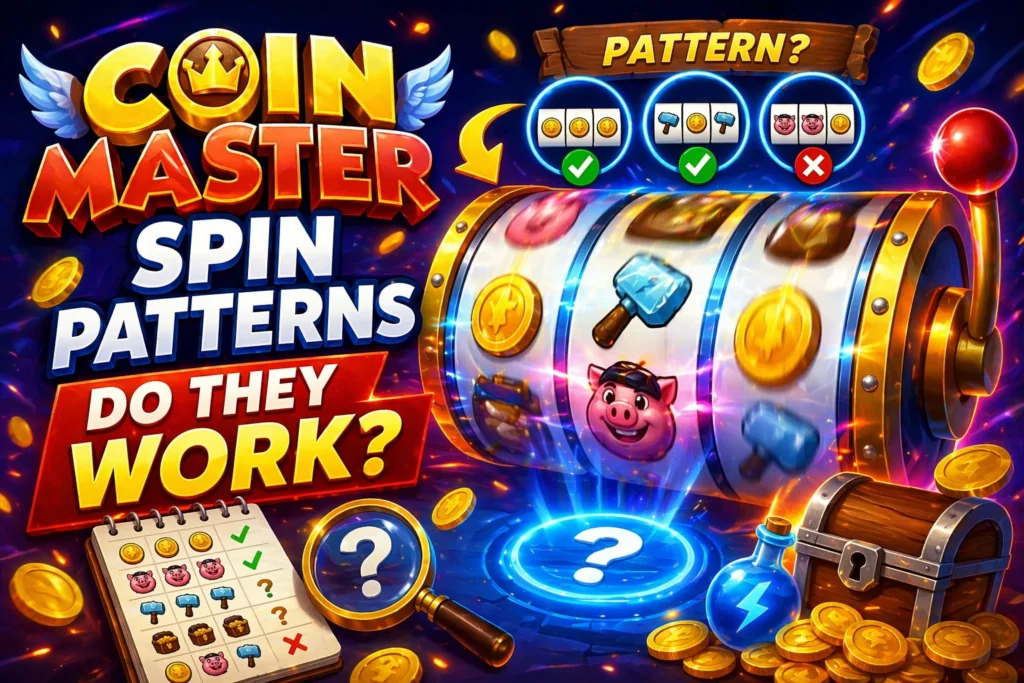
There is no proven spin pattern in Coin Master. Each spin is random, so patterns that seem to work are coincidence. What improves results is timing: spin during events, use the right pet, and raise your bet only when an event makes each result worth more.
Search "Coin Master spin patterns" and you will find thousands of posts, videos, and forum threads claiming to have cracked the slot machine. Spin 10 then stop. Spin 3 at a time. Switch bet levels every 5 spins. Spin only during certain hours. Close and reopen the app between sessions. The list goes on.
Some of these players believe what they are saying. Others are testing anything that seems to work. And a small number are deliberately spreading misinformation to mislead competitors in events. This guide gives you the honest breakdown: what the Coin Master slot machine is, why patterns feel real even when they are not, which claimed patterns have enough community consistency to be worth examining, and what strategies do produce better outcomes regardless of pattern belief.
In this guide
- Is the Coin Master Slot Machine Random?
- Why Do Spin Patterns Seem to Work?
- Popular Coin Master Spin Patterns
- Does Any Spin Pattern Work?
- What Really Improves Your Spin Results
- What Chasing Patterns Costs You
- What to Focus on Instead
- Can You Trust Spin Pattern Videos and Predictors?
- Frequently Asked Questions
Is the Coin Master Slot Machine Random?
Before evaluating any spin pattern, you need to understand what you are spinning. The Coin Master slot machine is a Random Number Generator, commonly called an RNG. This is the same underlying technology used in online casino slot machines, lottery systems, and randomised loot boxes in other mobile games.
An RNG does not have memory. Each spin is an independent event. The outcome of Spin 500 is not influenced by what happened on Spins 499, 498, or any spin before it. There is no internal counter ticking toward a guaranteed raid or attack. There is no cooldown period that makes certain outcomes more likely after a dry streak. The machine generates a fresh random result every single time you tap spin.
Moon Active has not published the exact probability weights for each outcome, but independent player data collected across millions of spins consistently shows that outcomes like raids and attacks appear at predictable average rates over large sample sizes, which is exactly what you would expect from a weighted RNG system. The probabilities are fixed. The sequence is random.
Why Do Spin Patterns Seem to Work?
If spin patterns do not work, why do so many players feel like they do? The answer is not that those players are naive. It is that human brains are wired to find patterns in random sequences, even when no pattern exists. This cognitive tendency has a name, apophenia, and it is the same mechanism that makes people see faces in clouds or hear messages in white noise.
When you spin 10 times, get a run of coin bags, then switch to spinning 3 at a time and immediately land a raid, your brain logs that as evidence that the switch caused the raid. It did not. The raid would have appeared at that point in the sequence regardless of how many spins preceded it. But because the switching action and the raid happened close together, the association sticks.
This gets amplified in the Coin Master community because people share their successes much more often than their failures. A player who tries the "spin 3 then pause" method and hits four raids in a row posts excitedly about it. The same player who does the same thing and gets nothing but coin bags for 200 spins does not post. The selective sharing creates the illusion that the pattern works more consistently than it does.
Popular Coin Master Spin Patterns
Here are the most widely circulated spin patterns in 2026, with an honest assessment of each:
The 3-Spin Stop Pattern
What players claim: Spinning exactly 3 times, pausing briefly, then spinning 3 more increases raid and attack frequency.
What is happening: The pause creates a psychological reset that makes the next 3 spins feel like a new experiment. Any raid that appears after the pause is remembered. Runs of coin bags between pauses are forgotten. No controlled data supports that pausing affects RNG output.
The Bet Switching Pattern
What players claim: Switching between x1 and x3 (or any two bet levels) in a set sequence resets the machine and triggers better outcomes.
What is happening: Bet level affects the size of payouts, not the frequency of outcome types. Switching between bets changes what each spin is worth but does not trigger different symbol distributions. Any pattern that appears during a switch would have appeared at the same point in the spin sequence without the switch.
The Time-of-Day Pattern
What players claim: Spinning during off-peak hours (early morning, late night) or at specific times of day produces better outcomes.
What is happening: Moon Active's servers handle millions of concurrent players across all time zones simultaneously. Server load does not affect individual RNG outcomes per player. No reliable data shows time-of-day correlation with outcome frequency across controlled sample sizes.
The App Restart Pattern
What players claim: Closing and reopening the app resets the spin sequence and puts you at the start of a more favourable cycle.
What is happening: The RNG sequence is server-side, not stored locally on your device. Closing the app does not change anything about the sequence the server will deliver to your next spin request. The app restart creates a placebo effect and nothing more.
The 10-Spin Observation Pattern
What players claim: Spinning 10 times first to observe the reel behaviour, then adjusting your approach based on what appeared, gives you better control over outcomes.
What is happening: 10 spins is an extremely small sample size for any RNG system. The distribution of outcomes in 10 spins tells you nothing predictive about the next 10 spins. This is equivalent to flipping a coin 10 times, getting 7 heads, and concluding the coin is biased toward heads.
Does Any Spin Pattern Work?
One claim circulates frequently enough and with enough player consistency that it deserves a more careful look: the idea that spinning at higher bet levels during events produces more frequent raids and attacks, not just larger payouts.
this specific claim is at least partially misunderstood. Higher bet levels do not change the probability of landing a raid or attack symbol. What they do is make each raid or attack outcome more memorable because the payout is sharply larger. A raid at x100 is an event. A raid at x1 is a footnote. Players who spin at high bets during events remember their raids more vividly and more frequently, which creates the subjective impression that high bets produce more raids per spin.
What is true about high bets during events is the value argument, not the frequency argument. More value per raid outcome is real. More raids per spin is not. The distinction matters because it changes how you think about your bet strategy, you should raise your bet during events because each raid is worth more, not because you will somehow land more raids.
What Really Improves Your Spin Results
If patterns do not work, what does? you cannot influence the RNG. What you can control is the context around each spin, and that context has a genuine and measurable impact on what each spin delivers in value terms.
These are the factors that change your outcomes, not by influencing the RNG, but by changing the value of each outcome the RNG produces:
- Active events. Spinning during Raid Madness, Attack Madness, or Village Mania produces more value per spin than spinning between events. The event multipliers are real and documented. This is not a pattern, it is a documented game mechanic.
- Active pets. Foxy active during raids adds a percentage bonus to every raid payout. Tiger active during attacks does the same. These are real percentage increases applied by the game system, not psychological effects.
- Bet level during events. As covered above, higher bets during active events produce larger per-spin value. Not more frequent raids, more valuable ones.
- Target selection during raids. Choosing higher-level raid targets produces larger coin pools to dig from. This is entirely within your control and has a real, measurable effect on coins earned per raid.
- Spin volume during event windows. Spending more spins during an event window simply produces more event progress and more event milestone rewards. This is a volume effect, not a pattern effect, but it is the most reliable way to consistently hit higher milestone tiers.
What Chasing Patterns Costs You
Spin pattern beliefs are mostly harmless in isolation. The problem is when they lead to bad decisions that cost real resources.
- Spinning between events to "find the right sequence." Every spin you use hunting for a pattern outside an event window is a spin that is not earning event multiplier returns. At scale, this is a significant opportunity cost.
- Stopping a high-value session because the pattern "broke." Some players stop spinning when their chosen pattern stops working, meaning they hit coin bags instead of raids for a stretch. Stopping a Raid Madness session early because you think the machine has turned against you means abandoning milestone progress that was still available.
- Using low bets because a pattern prescribes them. Several popular spin patterns recommend spinning at x1 for reasons related to "resetting" the machine. Spinning at x1 during Raid Madness leaves most of the event's coin value uncollected.
- Wasting spins on app restarts and artificial delays. Time spent restarting the app, waiting between spins, or performing ritual actions is time the event window is ticking down. A 24-hour Raid Madness window has a fixed number of spins you can realistically complete. Wasting any portion of it on superstitious actions reduces your total output.
What to Focus on Instead
Rather than tracking patterns, here is the mental checklist worth running before any significant spin session:
- Is an event active right now, and if so, which one?
- Does my pet match the event? (Foxy for raids, Tiger for attacks)
- Is my bet level appropriate for my current spin reserve and the event running?
- Are my raid targets well-matched to my village level?
- Do I have enough spins to reach the meaningful milestone tiers without stopping?
Every item on that list has a documented, measurable effect on what your spin session produces. None of them involve the RNG sequence, the time of day, the number of spins per burst, or the bet level you were on two sessions ago. They are all about the context you bring to the session, which is entirely under your control.
If you want to maximise the value of every spin you collect, the foundation is building and maintaining a healthy spin reserve so you always have enough to run full sessions during events. The free spins guide covers every legitimate source for keeping that reserve healthy without spending real money.
Can You Trust Spin Pattern Videos and Predictors?
A large amount of spin pattern content on YouTube and TikTok is produced by players who monetise through views and sponsorships. A video titled "THIS SPIN PATTERN GIVES UNLIMITED RAIDS" generates clicks. A video titled "Spin Patterns Do Not Work And Here Is Why" generates far fewer. This creates a strong incentive to produce and amplify pattern content regardless of whether it is accurate.
Some of these creators believe their patterns work. Others know their content is misleading but produce it anyway because the engagement numbers reward it. The most reliable way to evaluate any spin pattern claim you encounter is to ask one question: is this person describing a documented game mechanic, or are they describing a correlation they observed and assumed was causal? The former has evidence. The latter does not, no matter how many times the video has been watched.
Frequently Asked Questions
Do Coin Master spin patterns work?
No spin pattern has been demonstrated to influence the RNG in any verified, reproducible way. The Coin Master slot machine generates independent random results for each spin. Patterns feel real due to confirmation bias and the human tendency to find meaning in random sequences. What does produce better outcomes is game context, active events, correct pets, appropriate bet levels, and high-value raid targets, none of which involve pattern timing.
Is there a best time of day to spin in Coin Master?
No. Time of day does not affect the RNG or the probability of any specific outcome. Moon Active operates servers across all time zones simultaneously and individual player outcomes are not affected by server load or player volume at any given hour.
Does closing the app reset the spin sequence?
No. The RNG is server-side. Closing and reopening the app has no effect on the sequence of outcomes your account will receive. The server does not register an app restart as a trigger for any change in outcome probability.
Why do I sometimes get many raids in a row and then nothing for 100 spins?
This is normal RNG behaviour called variance or clustering. Random sequences naturally produce streaks, consecutive raids, long runs without raids, because each outcome is independent. A streak of raids does not mean the machine is in a special state. A long run without raids does not mean one is due. Both are expected features of random output over finite sample sizes.
Is spinning at x1 better than higher bets for getting raids?
No. Bet level does not affect the probability of landing any specific symbol type. Spinning at x1 gives you the same frequency of raid outcomes as spinning at x10, but each raid at x1 pays a fraction of what x10 would pay for the same outcome. The only genuine argument for x1 is spin conservation when you need to make a small reserve last longer.
Should I stop spinning when I am on a losing streak?
Only if the event you are participating in has ended or your spin reserve is too low to reach meaningful milestones. Stopping because of a perceived pattern or because you feel the machine has turned against you has no strategic basis. If Raid Madness is active and you have enough spins to reach higher milestones, continuing to spin is always the correct call regardless of recent outcome history.
Are there any spin strategies that legitimately improve results?
Yes, but they are all context strategies, not pattern strategies. Spinning during active events, matching your pet to the event type, using an appropriate bet level for your reserve size, and choosing well-matched raid targets all produce measurably better outcomes per spin. None of these involve timing, burst size, bet switching sequences, or any other pattern-based approach.